Understanding Coach Handbags: From Signature Canvas to Glovetanned Leather
The appeal of coach handbags comes as much from their materials as from their shapes. Two materials do most of the work: glovetanned leather, which Coach dates to the 1950s, and Signature canvas with its “C” monogram, introduced in 2001. Surrounding them are pebble and natural-grain leathers, regenerative leather, quilting, exotic skins and recycled leather fibers. Hardware is important as well, from the 1964 turnlock to the kisslock frame clasp.
Although Coach also sells shoes and coach clothing, this explainer concentrates on bags, taking each material and detail in turn. Any claim that is reported rather than confirmed is described that way. No official price list is used: all prices given are observed market prices.
What Is Glovetanned Leather?
A leather finish based on the way a worn baseball glove grows softer with use goes by the Coach name glovetanned leather. The idea is credited to Miles Cahn, who came to the Manhattan workshop in 1946 and purchased the business with his wife, Lillian, in 1961. Coach describes the leather as crafted to soften and improve the more it is carried. Detailed tanning chemistry is not documented in reliable sources, so treat technical claims about the process with care.
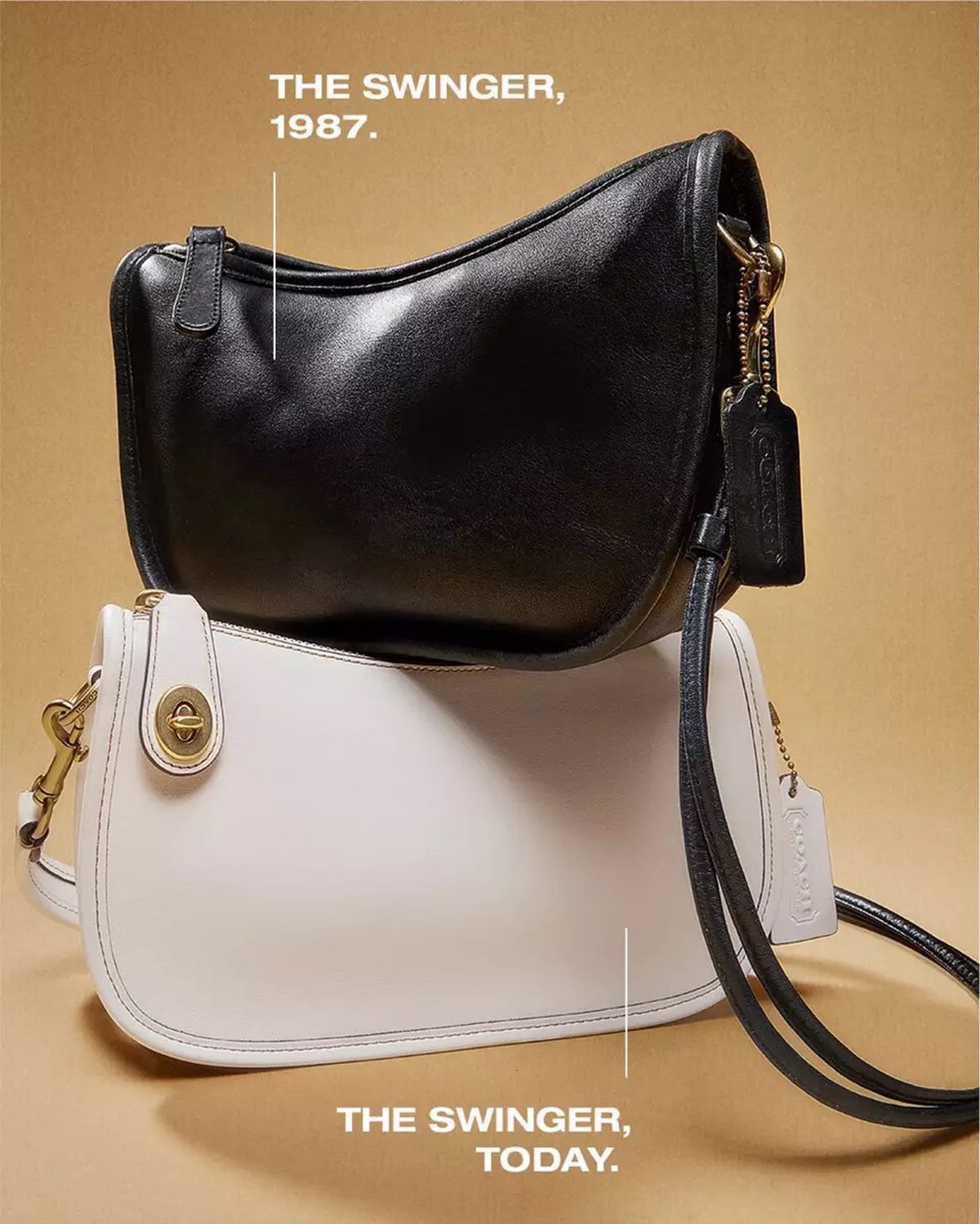
Current designs such as the Soho Bag 25, the Juliet 25, the Kisslock Frame Bag and the Swinger 20 use glovetanned leather, which is still a core material for Coach. At the lower end of full-price Coach bag prices seen in 2026 was the Kisslock Frame Bag, at an observed $350. Vintage glovetanned pieces also have a following among collectors, because the leather takes on a patina as it ages.
Coach’s Signature Canvas: What Is It and When Did It Arrive?
The fabric patterned with Coach’s “C” monogram pattern is called Signature canvas. The logo-mania of the early 2000s was the backdrop for its debut in 2001 as part of the Signature collection. Reed Krakoff, the creative director who joined Coach in 1997, reportedly oversaw its launch. Because the pattern has a classic look, many people assume it is a mid-century design, yet it arrived six decades after the 1941 workshop.
Coach now uses both Signature canvas and Signature jacquard, a woven designer fashion version of the pattern, across a wide range of lines. Current examples include a Juliet 25 in Signature canvas and a Soho 25 in Signature jacquard. The Tabby carries the monogram differently, as Signature “C” hardware rather than an all-over pattern.
Pebble, Natural-Grain and Regenerative Leather
Glovetanned leather does not appear on every leather coach bag, and the grain makes a difference to how a bag looks and wears. A Willow Bucket, a Willow Shoulder bag and the Willow Tote 24, a classic pebble-leather coach tote bag, have featured in the Willow family, a group shaped by pebble leather and its textured finish. The Brooklyn gets its relaxed, slouchy character from natural-grain leather, in both the Brooklyn 28 and the larger Brooklyn 39. An observed UK price for the Brooklyn 28 was £350.
Regenerative leather is used in newer versions of older designs, including a Rogue in Regenerative Leather and a Soho Flap Bag in Regenerative Leather. To confirm how each bag’s leather is described, the best source is the product descriptions on Coach’s own website. A structured coach shoulder bag and a soft hobo do not age alike, and so choosing between these leathers is largely a matter of taste.
Quilted Styles, Exotic Skins and Recycled Leather
Quilting has become one of the most prominent Coach treatments, helped by the success of the Pillow Tabby. The Pillow Tabby, launched in 2021, puffs up the Tabby shape with padded quilting and is sold under names such as Tabby Shoulder Bag 26 With Pillow Quilting. Observed prices for quilted versions ran higher than the $475 plain Tabby 26, and there is also a flatter quilted Tabby 26. Coach (Re)Loved is now the main place to see the Kisslock Dreamer 21 in quilted nappa leather, one of the older quilted styles.
Exotic skins occupy the opposite extreme: a Rogue 25 in alligator was observed at $8,000, the highest Coach bag price seen in 2026. At the heart of Coachtopia, the circular-design sub-brand Coach launched on 20 April 2023, sit recycled materials. Reports at launch said that Coachtopia bags contained at least 50% recycled leather fibers. Via restoration and upcrafting, Coach (Re)Loved, which launched in 2021, extends the life of existing bags.
Turnlocks, Kisslocks and a Horse and Carriage: Coach Hardware Explained
A brass toggle turned to secure a flap, the turnlock is Coach’s most recognizable closure. In Coach’s account, Bonnie Cashin found the idea in the toggle on the top of her convertible and went on to introduce the closure in 1964. Coach’s own pages give her start year as both 1961 and 1962, while she is reported to have designed for Coach on contract until 1974. Turnlocks still show up on current designs such as the Cassie Crossbody Bag 19 and the Swinger Bag 20.
Inspired by vintage coin purses, the kisslock is a frame clasp that Coach links to the Cashin era. Do not confuse the Kisslock Frame Bag with the Kisslock Barrel Bag: the name covers several different bags. No reliable date can be given for the horse-and-carriage emblem, another long-standing Coach symbol, as sources differ on when it first appeared.
The Limits of Storypatches and Hangtags
Every Coach bag, Coach says, has a Storypatch; the sewn-in patch bears a short statement about Coach craftsmanship and a unique registration number. Older versions are often called a creed by collectors, and resale guides report that the earliest creeds were not numbered at all. According to Coach, its leather hangtag first appeared in 1972. A patch by itself is not proof of a genuine bag: counterfeiters copy patches too, even though Coach presents the Storypatch as a mark of authenticity.
Coach will not authenticate merchandise or confirm serial numbers for shoppers, it also says. What it recommends is to get bags from Coach stores and outlets, Coach’s own website or approved retailers. Resale guides also suggest physical checks, including solid hardware with some weight, straight stitching and a patch stamped into the leather rather than printed.
Bag Materials at a Glance
The following table summarizes the main materials and details seen on Coach bags, each with an example of where it appears. Dates appear only when they are documented, and that is why several rows note that the date is undocumented. Prices are observed market prices, not an official list, and they change with size, color and promotions. Because one bag often comes in several materials, the material can weigh as heavily as the model name when you compare prices. The Tabby 26 and the Empire Carryall 34 alike were observed at £475 in the UK, for example. Glovetanned leather is made to soften with use, but structured styles are built to hold their shape, so materials also shape how a bag ages. Before buying, consult the product description on Coach’s own website if the material is not clearly named in a listing.
| Material or feature | What it means | Documented date | Example style |
|---|---|---|---|
| Glovetanned leather finish | Soft finish inspired by a worn baseball glove | Coach dates it to the 1950s | Kisslock Frame Bag (observed at $350) |
| Signature canvas | Fabric covered in the “C” monogram | 2001 | Juliet 25 in Signature canvas |
| Signature jacquard fabric | Woven take on the monogram | No documented date | Soho 25 in Signature jacquard |
| Pebble leather | Leather with a textured grain | Undocumented | Willow Tote 24 |
| Natural grain leather | Relaxed leather with a slouchy feel | Brooklyn launched August 2024 | Brooklyn 28, observed in the UK at £350 |
| Pillow-style quilting | Padded, puffy quilting | Pillow Tabby launched 2021 | Tabby Shoulder Bag 26 With Pillow Quilting |
| Exotic skins | Alligator and other exotics | No documented date | Alligator Rogue 25, observed at $8,000 |
| Turnlock closure | Brass toggle closure | 1964 | Cassie Crossbody Bag 19 |
| Kisslock | Coin-purse frame clasp | The Cashin era | Kisslock Barrel Bag |
Coach Outlet Materials: What Is Known
Coach Outlet is Coach’s own official channel, so a coach outlet bag is a authentic Coach product. What is less clear is how outlet materials stack up against those of a full-price coach store. Back in 2014, Coach’s head of investor relations was quoted as saying that around 85% of outlet merchandise was made for the outlet channel, though that figure is now dated. Consumer blogs and social videos claim some made-for-outlet items use lower-grade leather, coated canvas, lighter hardware or simpler linings, while other sources point out that differences depend on the style.
No public Coach comparison of specifications has been found, so claiming that outlet bags are always worse, or exactly the same, goes further than the evidence. Tapestry has also talked about bringing some full-price collection product into outlets, which clouds the line further. Before about 2020, made-for-outlet style numbers typically started with an “F”, but newer style-number formats render that signal unreliable for recent bags. The most dependable signal today is where you purchased the bag, whether a Coach Outlet store or the official online outlet section on Coach’s own website.
Leave a Reply